If it's Valentine's Day, then it has to be red. And if it's red, it has to be Red Velvet Cake.
This rich and luscious cake was made for love, so what better excuse did I need?
The buttercream, the cocoa in the sponge, the utter indulgence of three layers of cake!
Need I say more?
Friday, 14 February 2014
Sunday, 20 October 2013
Tibetan steamed dumplings
Rick Stein's India, In search Of The Perfect Curry
Recipes From My Indian Odyssey
Rick Stein's cookbooks are good value, every time. His enthusiasm for the country he is in as well as the food he discovers and recreates in the books, makes them part-fascinating travelogue along with the added bonus of tempting recipes galore.
Lucky us. We may not be able to travel to India but we surely get a taste of Rick's travels there.
These dumplings were delicious. Easy as pie to make (actually easier than pie), they are really wonderful with the Tibetan chilli dipping sauce, also quick to knock up.
The dough is perfectly straight-forward and takes no longer than three minutes to make. While it rests for ten minutes, lamb mince, onion and ginger are combined in a bowl and when the dough is cut into 16 pieces and rolled out, the lamb is placed into the half-circle middle and the dough edges are pinched together, rather like ravioli.
The only thing needed to make them divine to eat (and it was the Tibetan monks with whom Rick ate these) was a quick and fiery Tibetan dipping sauce made using chillies, garlic, rice wine-vinegar and oil. You can see it on the right, above.
Unfortunately, these dumplings are rather like making pancakes ... make sure you don't tell anyone you're making them until you've finished cooking. Like making pancakes, you might find they get eaten as soon as you lift them out of the pan, which means you can't make them fast enough to sit down and enjoy them with everyone else!
Tibetan steamed dumplings
Rick Stein's India, In Search of the Perfect Curry, Recipes from my Indian Odyssey
Rick Stein, BBC Books, an imprint of Ebury Publishing, Random House Group, 2013
Rick Stein's India, In search Of The Perfect Curry
Recipes From My Indian Odyssey
Rick Stein's cookbooks are good value, every time. His enthusiasm for the country he is in as well as the food he discovers and recreates in the books, makes them part-fascinating travelogue along with the added bonus of tempting recipes galore.
Lucky us. We may not be able to travel to India but we surely get a taste of Rick's travels there.
| Tibetan dumplings, ready for steaming (I think these somehow look like little monks all huddled together). |
These dumplings were delicious. Easy as pie to make (actually easier than pie), they are really wonderful with the Tibetan chilli dipping sauce, also quick to knock up.
The dough is perfectly straight-forward and takes no longer than three minutes to make. While it rests for ten minutes, lamb mince, onion and ginger are combined in a bowl and when the dough is cut into 16 pieces and rolled out, the lamb is placed into the half-circle middle and the dough edges are pinched together, rather like ravioli.
| dough is rolled out, lamb mince placed inside and made into dumplings |
The only thing needed to make them divine to eat (and it was the Tibetan monks with whom Rick ate these) was a quick and fiery Tibetan dipping sauce made using chillies, garlic, rice wine-vinegar and oil. You can see it on the right, above.
Unfortunately, these dumplings are rather like making pancakes ... make sure you don't tell anyone you're making them until you've finished cooking. Like making pancakes, you might find they get eaten as soon as you lift them out of the pan, which means you can't make them fast enough to sit down and enjoy them with everyone else!
Tibetan steamed dumplings
Rick Stein's India, In Search of the Perfect Curry, Recipes from my Indian Odyssey
Rick Stein, BBC Books, an imprint of Ebury Publishing, Random House Group, 2013
Saturday, 27 July 2013
Scones
This month's Daring Bakers' challenge was to re-make or make-anew a recipe from one of the many previous challenges. I chose the scones from January 2012, never having made them for a Daring challenge before.
A deceptively simple recipe, scones do not always readily come out as the light and fluffy versions that I remember my grandmothers and mother used to make. And each batch I've ever made seems to be a bit different.
Plain flour, baking powder, salt, cold butter and cold milk are mixed lightly together to meld into a dough. The least amount of mixing and handling with your hands, the better.
The dough is gently patted out flat so that the scone cutter can be used to make clean-edged scone shapes which helps them rise.
These are put onto a well greased baking sheet or parchment paper and cooked for 20 minutes or until golden.
The best part is breaking apart the warm, steaming scones and then covering the with lashings of cream and sweet strawberry jam - the simplest yet most elegant of accompaniments.
And of course, a scone without a proper cup of tea is not a proper scone!
A deceptively simple recipe, scones do not always readily come out as the light and fluffy versions that I remember my grandmothers and mother used to make. And each batch I've ever made seems to be a bit different.
Plain flour, baking powder, salt, cold butter and cold milk are mixed lightly together to meld into a dough. The least amount of mixing and handling with your hands, the better.
The dough is gently patted out flat so that the scone cutter can be used to make clean-edged scone shapes which helps them rise.
These are put onto a well greased baking sheet or parchment paper and cooked for 20 minutes or until golden.
![]() |
| hot out of the oven ... |
The best part is breaking apart the warm, steaming scones and then covering the with lashings of cream and sweet strawberry jam - the simplest yet most elegant of accompaniments.
And of course, a scone without a proper cup of tea is not a proper scone!
![]() |
| To be eaten smothered in jam and cream |
Thursday, 4 July 2013
Henley Royal Regatta picnic
![]() |
| deck chairs ready for spectators, right on the river |
Henley Royal Regatta. This 5-day rowing event has been held annually since 1839 and for those unaware of Henley, you might think it is just another rowing day on an expanse of river with home crews competing against each other, but it is not. This very special rowing event draws crews from around the world who look forward to meeting old international rivals, in a very traditional English setting, at the very traditional time of the English summer. It is rather like going to Wimbledon, and attracts not only the competitors and lovers of the sport but also people who come purely to take part in something very English. Dress code for the Stewards' Enclosure is strict - ladies must wear dresses/skirts below the knee (absolutely no trousers allowed) and men must wear suitable jacket and tie.
![]() |
| the last few metres of the 2-mile course. |
![]() |
| scoring notification - how it has always been done |
For rowers Henley is prestigious. For non-rowers, it's a great day out to pose in one's regatta finery.
![]() |
| A lot of women look like they're at Ascot, but I thought this woman looked beautiful. |
But to food lovers, Henley is all about The Picnic.
After the morning racing, (and if you are not lunching here):
you can go back to your Rolls or classic vintage car where you have parked nearby in grassy car parks. There's plenty of room between the rows of cars to allow for owners to spread out picnic tables, umbrellas, chairs and in some cases, candelabras (!) and table settings to enjoy luncheon from 12.30pm - 2.00pm, at which time all races are suspended. Pimm's is the drink of the day and delicious food is always expected.
![]() |
| (notice the Veuve Clicquot) |
So today with our Bollinger and Pimm's we had smoked salmon sandwiches, ham & grain mustard sandwiches, quiche, rocket salad, chipolatas, humus, breadsticks, vegetables and to finish strawberries, cream. For afternoon tea we had fruit cake with a cup of tea.
To me, Henley is all about the picnic.
Saturday, 25 May 2013
cheesecake
family recipe
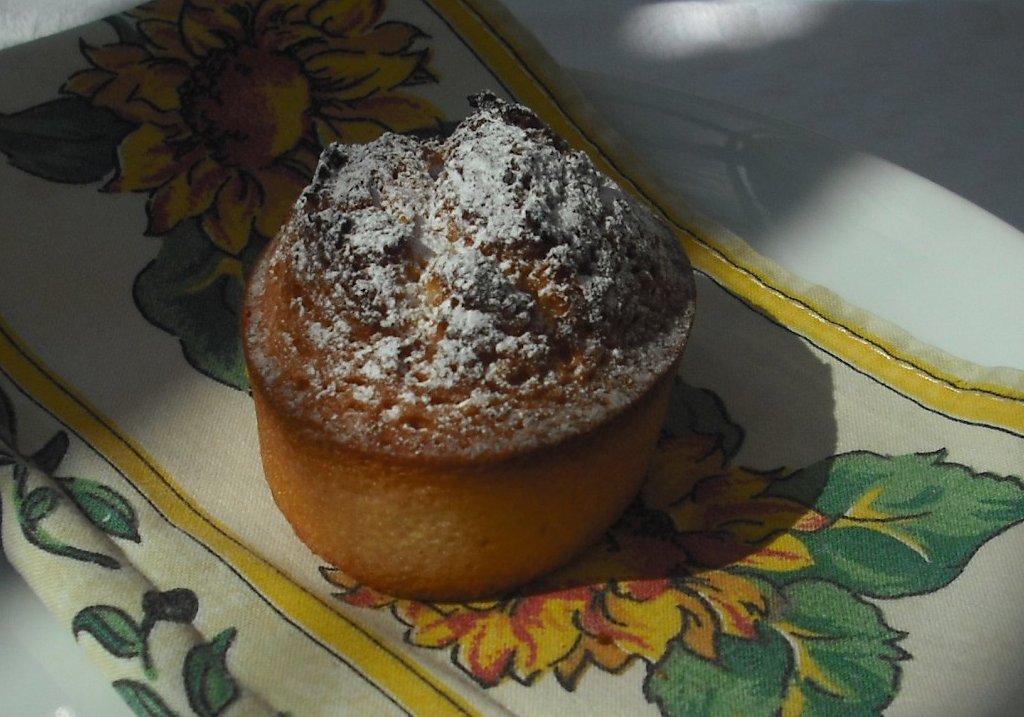
So I decided to make a cheesecake. And it turned out like this:
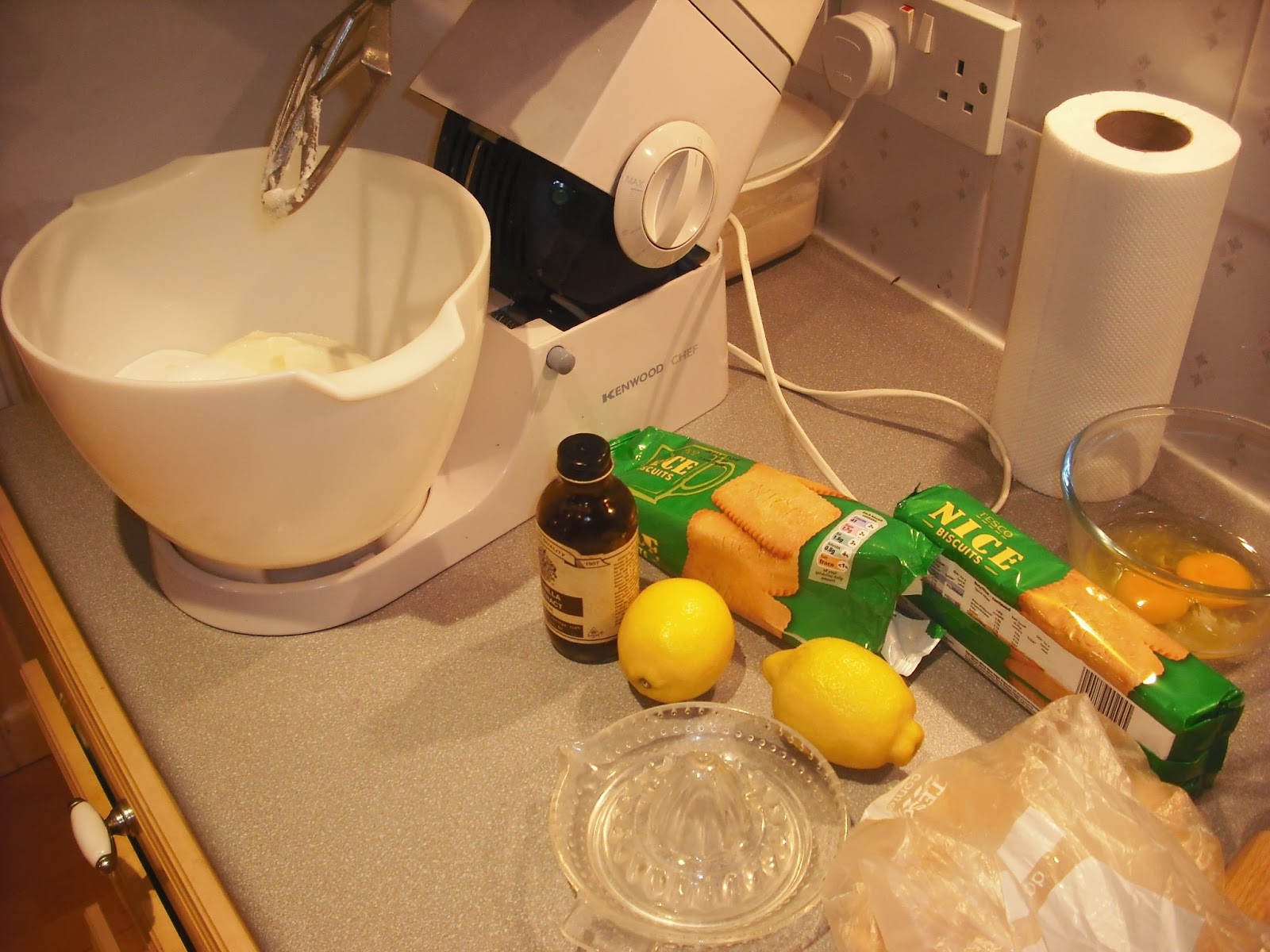
When you have a favourite recipe, nothing else will do. In this particular case, my Dad's is the best I know. The ingredients are these:
These are the other ingredients:
So I decided to make a cheesecake. And it turned out like this:
When you have a favourite recipe, nothing else will do. In this particular case, my Dad's is the best I know. The ingredients are these:
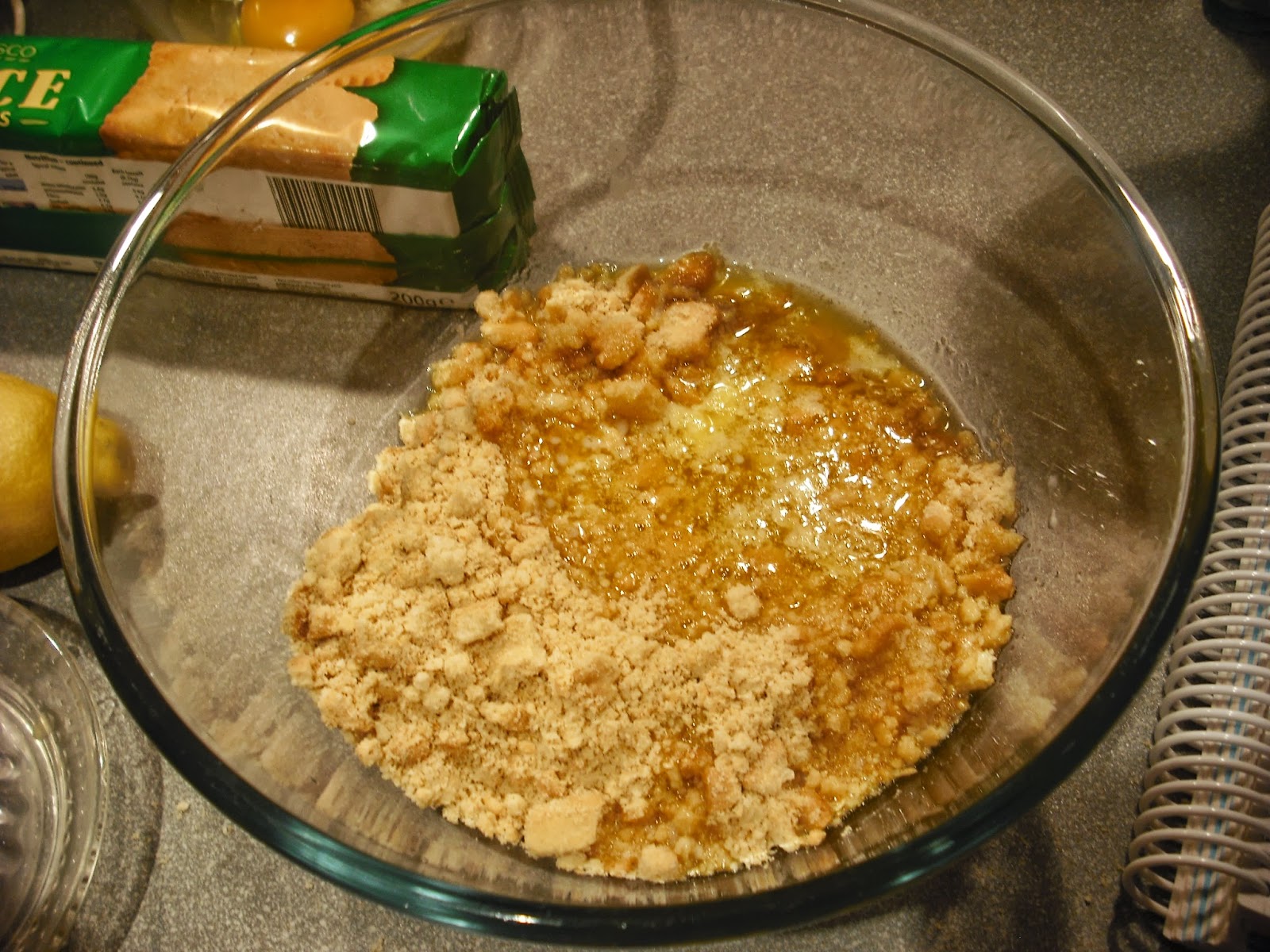
| crushed Nice biscuits with melted butter |
First off, you must prepare the biscuit base. This is the most tedious part but once it is done, the rest is quick and simple. Leave the butter to melt whilst crushing the biscuits by placing them inside a plastic bag then bash with a wooden rolling pin (quite therapeutic).
Place the biscuits into a bowl and add the melted butter and mix thoroughly.
Line a spring form tin with the mixture, first using a spoon to spread and then a flat-bottomed glass to help the mixture firm up. The straight sides of the glass help especially when forming up the sides of the tin. This can be a pain if you're in a hurry - so don't make it if you're in a hurry! This is also quite therapeutic
| Philadelphia cream cheese, sugar, eggs, lemon juice and vanilla extract |
The Philadelphia (full-fat) cream cheese and sugar are beaten with 3 eggs, some vanilla and lemon juice.
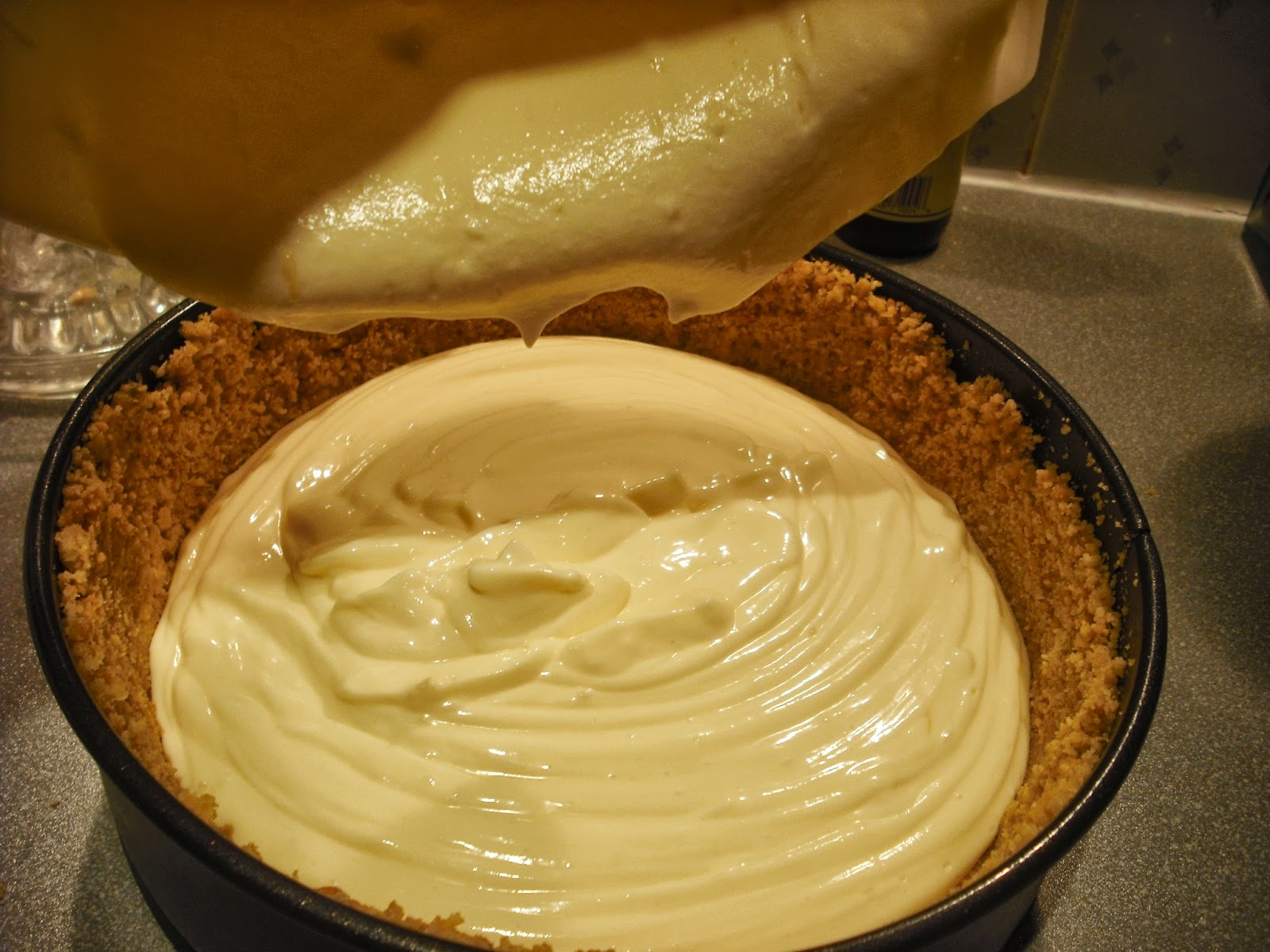
Then pour into your prepared biscuit base:
smooth out:
then bake, 180 deg C (350 deg F) for 30-40 minutes, depending on your oven. Mine took 35.
And, here it is.
Leaving it to cool at around midnight, I went out to get my daughter who had been babysitting. Of course, we came home to smells of freshly baked cheesecake were too irresistible, and against all my protestations, a hungry babysitter could not resist a small slice before it had even cooled properly.
Nevertheless, here it is this morning, having been refrigerated overnight. And it tastes great fridge cold.
Doesn't it look good? It was!
Saturday, 4 May 2013
semi-sourdough
semi-sourdough Bourke Street Bakery Paul Allam & David McGuinness |
| semi-sourdough, with brown flour |
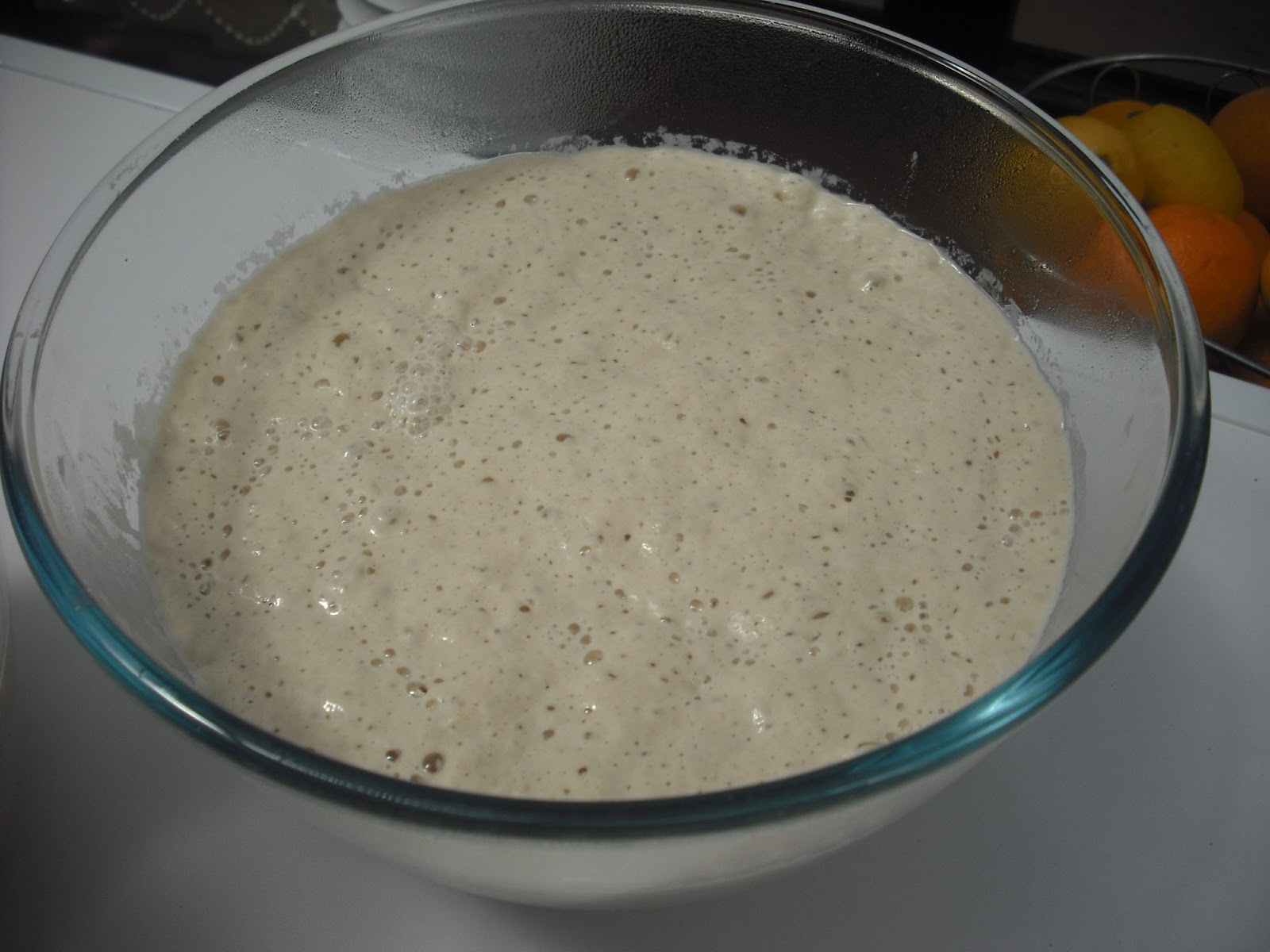
| white starter |
The resulting dough was smooth and elastic, and left to prove, covered with plastic:
| Dough ready for covering with film and proving for one hour. |
It was then knocked back:
and left to proved, covered with plastic, for another hour.
The dough was then ready to be divided into 3 x 500g balls, then rested for 20 mins.
I didn't have the required small loaf tins, so I just used my ordinary enamel dishes, and they worked well. I only had two so had one loaf left over which I put into my normal loaf tin.
Then these were put into the fridge for one hour. The loaves were removed from the fridge and left for a further 1.5 hours until each loaf had grown in size by two-thirds. In the meantime, the oven was turned on to 200 deg C.
The loaves were put into the oven, spraying it with water before closing the door.
After 20 mins, the loaves were turned around in the oven and then baked for a further 10 minutes.
Here they are, straight out of the oven. I haven't noticed this with other loaves, but the crust continued to make cracking sound for about five minutes after they came out of the oven. Is this the normal result of a good crust, I wonder?
PS 17/10/13:
Baking from this book is a dream. I go back to it time and time again, and this loaf has become our everyday loaf. I now use most of the dough for a larger loaf, for the above dark tin, and the rest I make into a baguette and generally freeze it soon after it has cooled. I now have a stack in the freezer and it is wonderful for pulling out on the weekends for lunch.
If you can afford it, buy this book. I doubt you will need another.
I was really pleased with this loaf. It was lighter than the sourdough loaf, but retained the chewy crust. I am especially pleased with the substitute brown flour instead of white. I really had a lovely flavour.
| brown semi-sourdough, very light and delicious nutty flavour |
Thursday, 2 May 2013
friands
almond friands
Australian Women's Weekly, Cakes and cupcakes
I haven't made these delicious little cakes in a good, long while and I only first made them a couple of years ago when I saw a recipe in The Australian Women's Weekly Cookbook of Cupcakes and Baking, although they've been around for at least ten years in Aus. They're so quick and easy to make.
The friand is a very popular little cake in Aussie cafes but is not known very well on these shores. I worked in a bakery not so long ago, and when I asked, they had never heard of them. Mind you, this bakery was not very adventurous. Although they made truly wonderful artisanal bread and pastries and cakes (all hand made), there was never anything new. They made great bread including sourdough, rye and spelt but wouldn't go near gluten-free. Clearly this is an issue these days and the number of people who, either in the bakery shop or out at a farmers' markets, would ask for gluten-free bread happened every shift I worked on. Why wouldn't you seize these enquiries as a reason for a new product? Why wouldn't you want to cater for what your customers asked for?
This is something which I cannot fathom. If you are in business then surely, it is to make money? You would naturally (I would have thought) adapt to your customers' needs, keep your customers interested with new items whilst retaining those items in demand for which you had built up your reputation, thereby keeping everything new and interesting so people would keep coming back. This bakery never made any new products, never advertised (how is that possible in this day and age?) and kept to within the confines of 'we've always done it this way' which is good, but extremely limiting. It was obvious how successful they could become: they were exactly 'on trend', adhering to their 30-yr history, were proponents of the Real Bread movement, and it was patently obvious they should have capitalised on who they were. They were unique and had provenance! Instead, although outwardly an established 'brand' locally which was very Country Living magazine (and we are in the country here), I fear it was either arrogance or short-sightedness which seemed to keep them from moving on.
Which is what I should do. Where was I? Ah yes. The friand. (Blogger keeps changing it to friend).
I think friands are a derivation of the financier which is a little French cake, once-up-a-time made in little bar shapes, no unlike gold bars and thereby associated with finance, hence Financiers. How they made it to Australia and became friands I don't know. Perhaps that is the way of Australian food: it has come from somewhere else, been adapted and then made to reflect the Aussie lifestyle and climate, becoming something it was originally not, and then they make it their own.
As I said, this recipe comes from The Australian Women's Weekly Cookbook of Cupcakes and Baking, purchased here in the UK about three years ago as an excuse to buy what I thought was an essential reference for my wish to baking for a living.
The recipe requires egg whites, sugar, ground almonds and a little flour. Using egg whites, gently beat for a minute. Add them to the rest of the ingredients and combine carefully. And that is literally it.
As an introduction to those unfamiliar with friands, these ones are the basic almond friand. It is my intention to later explore more flavours with this versatile little cake.
So, what you need first off is a friand tin or silicon pan. The Aussie friands traditionally have an oval shape and when I went to shop for the pans, I never found them because, remember, friands are not popular here so I found a silicon one on the Internet. I don't really like baking with silicon as I prefer a strong tin when I turn them out onto the wire rack when they're still hot from the oven. Silicon is very wobbly. I'm not comfortable with wobbly.
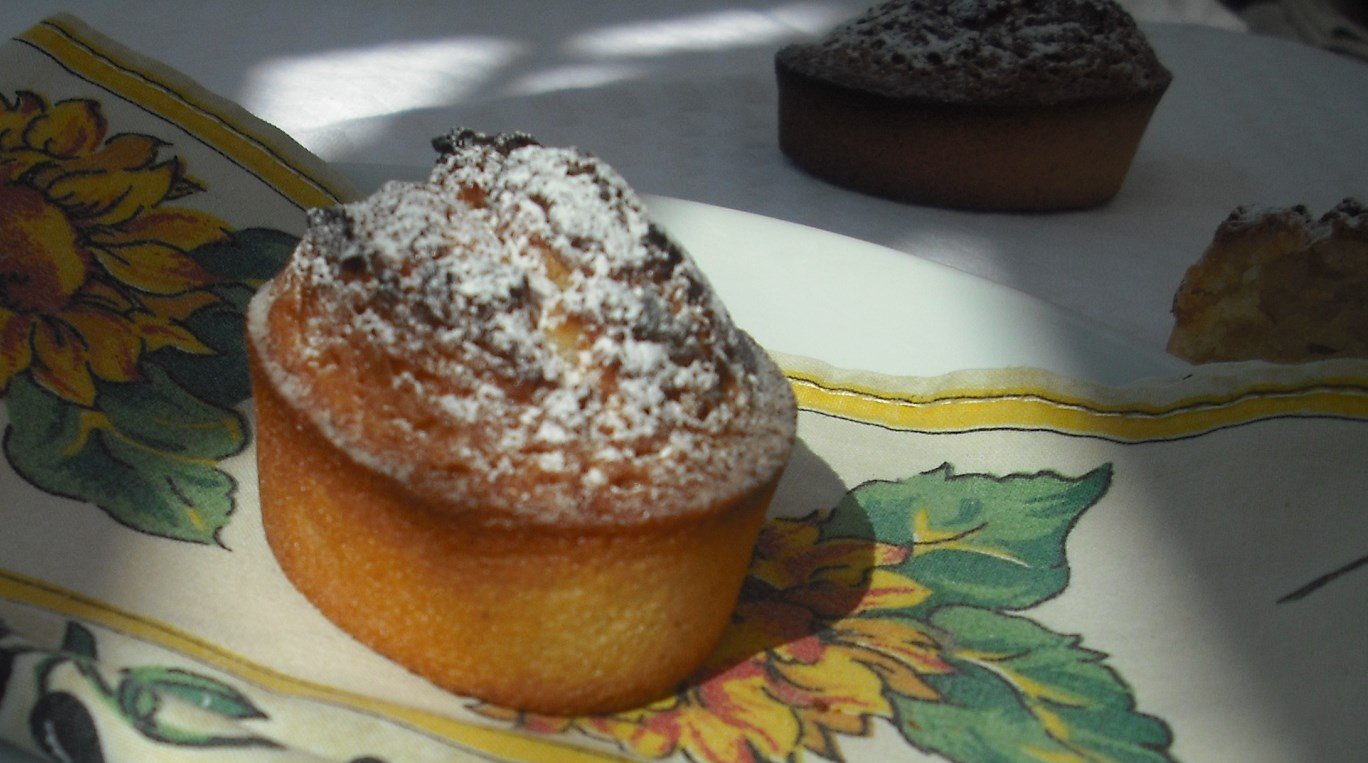
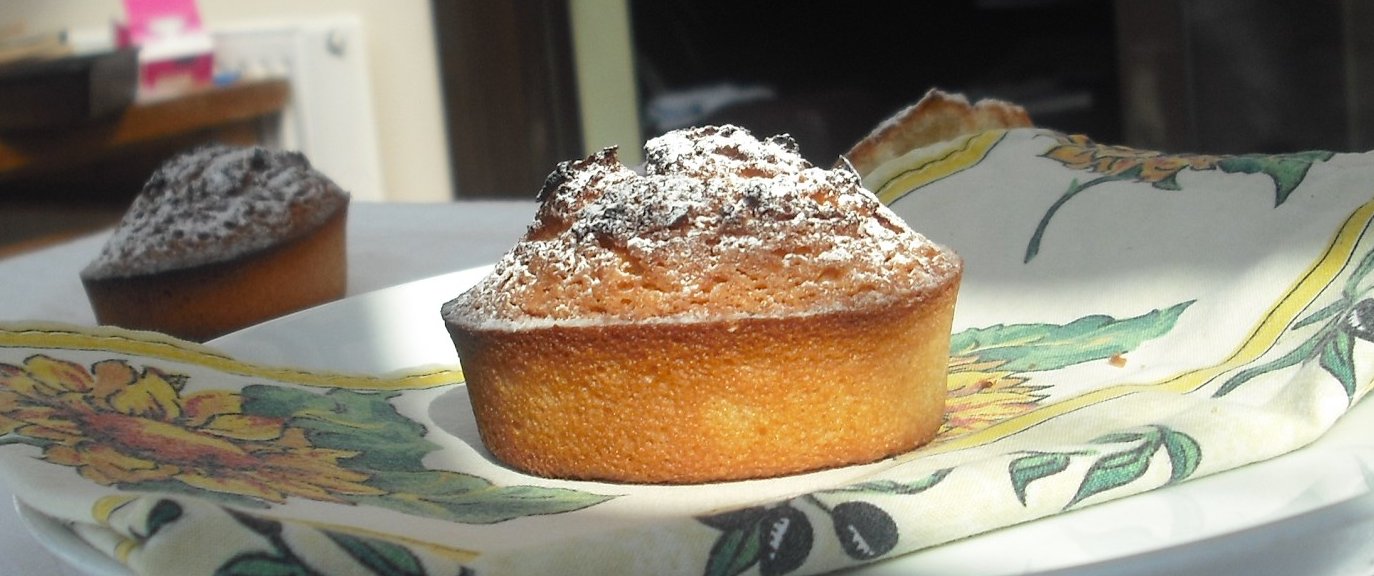
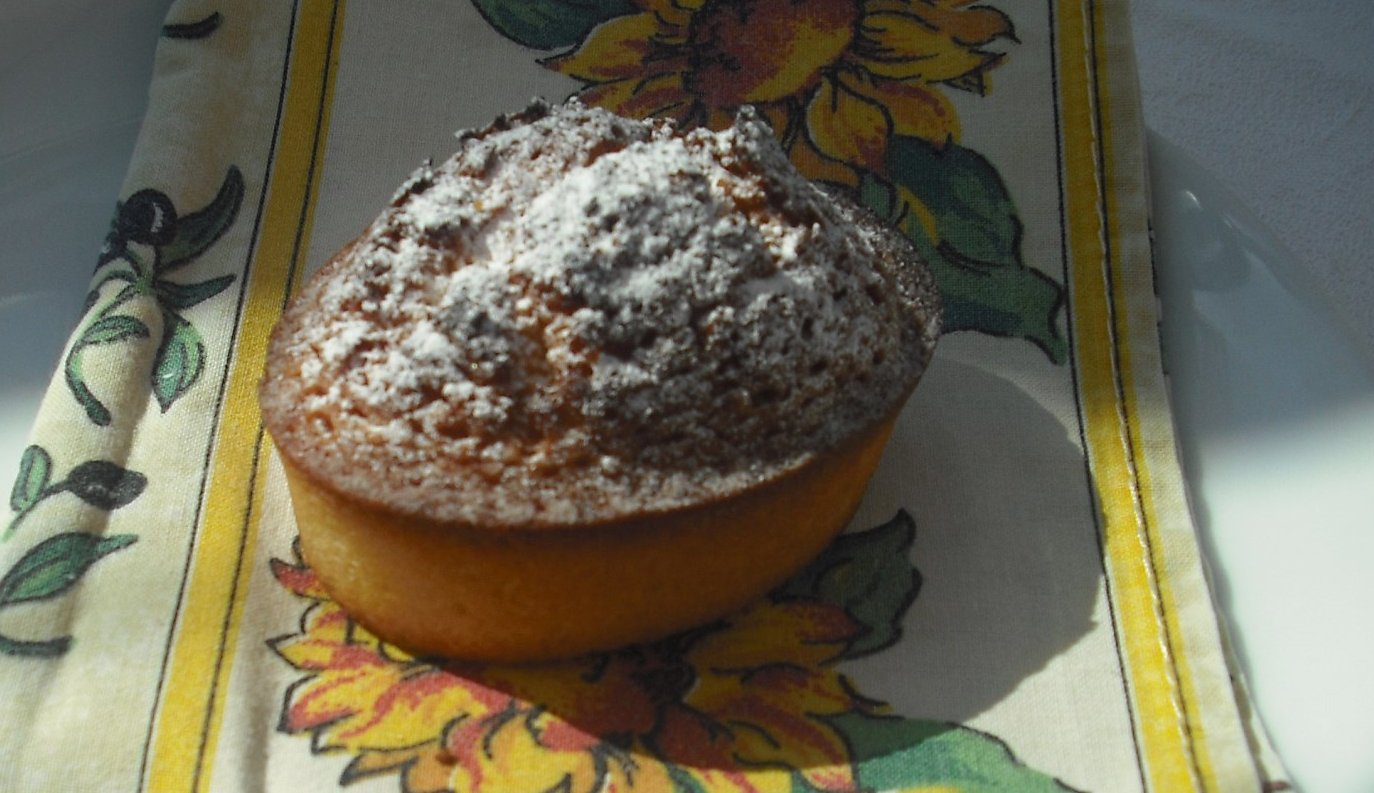
A dusting of icing sugar is all that is usually done to finish them off .
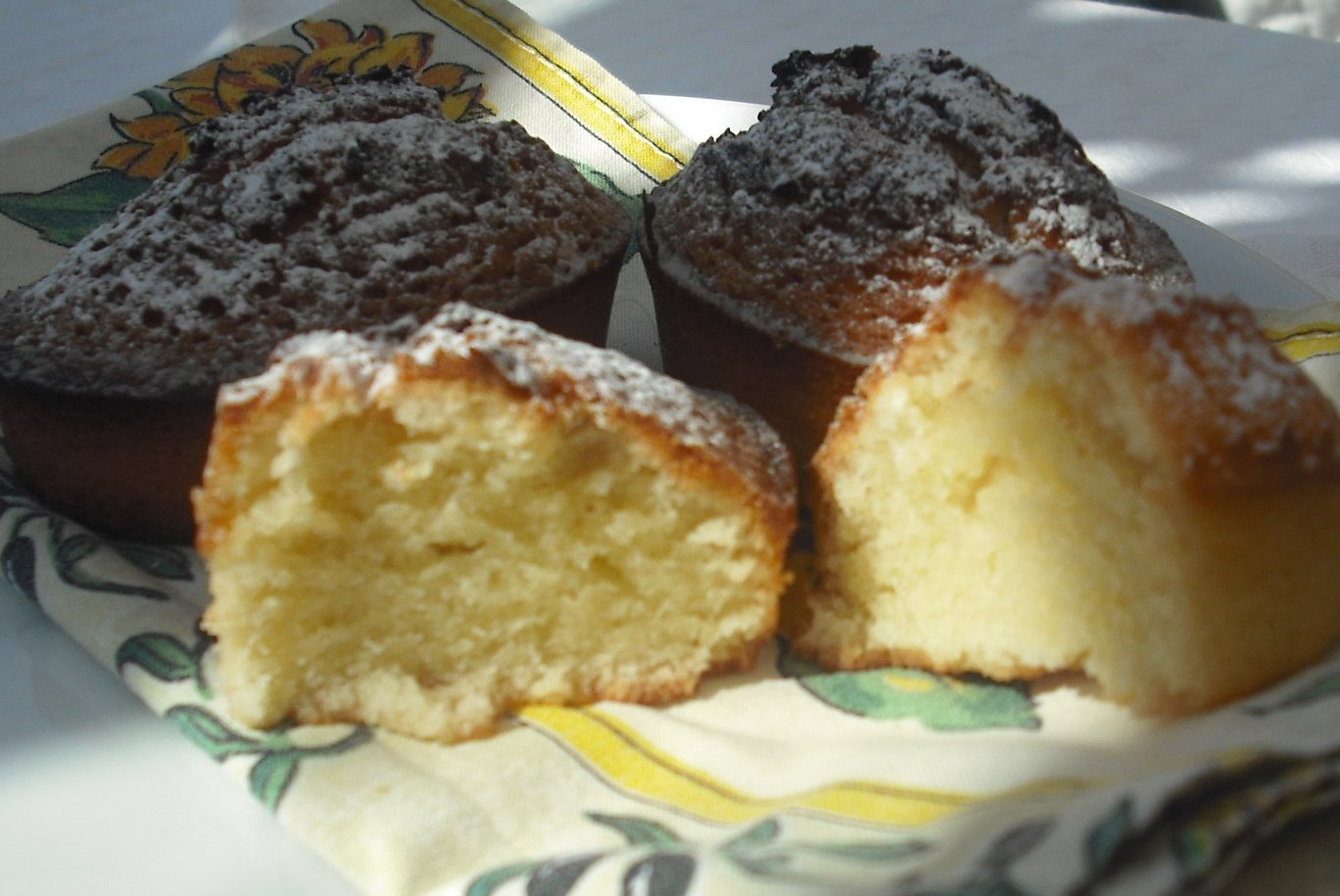
They are a dense, but very light moist cake and are real keepers. They last in the tin for a week.
Perfect with a cup of tea. Or even morning coffee. Or late night indulgence when no one's looking ...
Think I'll go and have another one now.
The Australian Women's Weekly Cupcakes and baking
Subscribe to:
Posts (Atom)